Tuesday, April 10, 2007

Left is right -- we're driving!

We spent the weekend practicing driving in our new (used) Toyota Rav 4. Why are we practicing?

First, here is the recipe for Ugandan roads: Combine huge potholes; the stray cow (or entire herds); people walking, walking, walking within inches of your side mirror; bicycles piled high with jerry cans; goats grazing in the ditch; construction to supposedly fix the potholes; little kids rolling a bicycle inner tube along the shoulder. Take all those and stretch them out in a line to make a road, then add cars, boda-bodas, trucks, buses and taxis, each zooming to get around each other and the potholes -- and out of the way of oncoming traffic. For spice add the fact that there are no lanes or center line, and that trucks and buses are overloaded and speeding. And everyone is honking.

Then there are the boda-bodas (motorcycle taxis). They come up on your right, left, in front and behind, and sometimes they are going in the wrong direction. Almost everyone we know has hit a boda man, or been hit by one; side mirrors are mostly cracked or missing. And if you hit one, a crowd gathers because everyone figures they will get paid off by the car driver for siding with the boda man. Or so we've been told.


And there's that bit about driving on the left. (But those of you in Bath with us going to Harry Potter's home or whatever it was will remember the fun of that!) We've pretty much got that down (we think).

And almost every time we have gone anywhere of any distance we see major accidents. We aim to avoid being the victim of those!


So REAL the question is, why did we get a car with all this danger around us? We've been using drivers and walking, which is great. But this is not an easy city to get around in, and we were extremely tired of using drivers for every little thing, plus it is expensive. We can still hire a driver, but use our car, if we feel like it. Mainly it gives us freedom.


For example, yesterday we drove to the Gaba Market on Lake Victoria. We had no idea what to expect, we just went. And it was great: fisherman with loads of fish, a woman selling dead grasshoppers (they fry them), ferries to islands in the lake (see pix - the ferry says "In God all things are possible" -- presumably even this ferry arriving safely), even a medicine man selling vile looking potions in bottles displayed on the hood of his car. We asked what was in them and he said it was medicine made from trees and herbs. Then he slyly looked at Bill and said they would make him "strong." And he didn't mean his triceps.


Also, we went to a play -- it lasted 4.5 hours, mainly in Luganda though they swore it was in English -- just because we could.


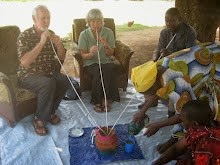
Above Bill is holding the worry beads, which are now hanging in our car. So we are well protected.

Monday, April 2, 2007

Snow, cotton candy and crazy mzungus

This past Saturday we went to a village called Kammengo with our friend Matthias who is a priest in that parish. Matthias lined up some kids for us to meet for a video the Sister School people in Seattle want to make when they come later this month. They were mainly about 11 or 12, speak a little English and are apparently quite gregarious -- until they see a white person.

To get them talking, Bill asked them if they knew what snow was, and they didn't. So he explained how it falls from the sky, and kids slide on it, and make snowmen from it. Their faces got scrunched up as they tried to envision this - and to understand these white people.
So he tried another tack (okay, it was my idea, and I admit not a good one). He described cotton candy, and their faces looked even more scrunchy. So he tried Easter baskets, and dying Easter eggs -- now they just thought he was crazy. At least they laughed.

We met them at the parish churchyard, which is lovely. Bright yellow weaver birds strip banana leaves to make these intricate nests in the trees, and they make lots of noise while they weave. They rejected one of the nests and it fell to our feet so I took it home for an Easter basket, no matter what they think of us.

The church is 60 years old and is crumbling a bit in the humidity. Inside, the benches are mostly broken, the confessionals in ruins. Matthias explained that during the war (which ended in 1986), the soldiers stayed in the church and smashed everything and there is no money to fix it. Also, in the yard there is a gun they abandoned on their way out; it's extremely incongruous to see it in this peaceful setting. But that recent history is evident throughout Uganda and we meet plenty of people who just want peace at almost any cost.

At any rate, we had a peaceful lunch with the pastor and Matthias. And we'll be back to see the kids. Maybe we can think of another story about America for them, something a little easier to grasp.

Wednesday, March 28, 2007

Glad I didn't!

Before we came to Uganda I went onto the Habitat for Humanity site and looked at what volunteer projects they had here. One of them was digging latrines at Habitat villages. "I can do that!" I thought.

Well, last week I went out to Mukono to the Bead for Life/Habitat village being built by and for the beaders. I was snapping pix and getting some video to document the groundbreaking. The beaders were wielding hoes to dig their foundations - it was all very exciting.

One of the first things a new village needs is, of course, latrines. I'm not talking about little holes in the ground; these are the Grand Canyon of latrines! The guys digging these were down in huge rectangular (they are two-holers) grave-like holes, tossing dirt high above their heads to the surface above. The finished latrines are more than twice the height of the diggers; they dug steps in the sides so they could get out. And it was hot above ground, much less down below.

Fortunately for me, Habitat hired some local, very muscular, workers to dig these things. It was hard to get a picture of the work, but you can get an idea. I think I'll stick to being behind the camera.

Saturday, March 24, 2007

Oh! The neighbors have a visitor!

We heard a banging noise yesterday morning. Theresa looked out our bedroom window -- "There are monkeys all over the parking lot!" Yes, they were back again, and in a frisky mood. Swinging from the branches. Bouncing off the top of a Rav4 (that was the banging noise) and down to the ground. Doing their vertical jumps, straight up two or three times their own height to grab a tasty bunch of leaves. Zipping up the drainpipe to the top of the building next to us.

One of the monkeys discovered the open, unscreened bathroom window in a third-floor flat. Pretty soon he stuck his head in cautiously, then his whole body, then the only thing visible was his tail disappearing inside. Perhaps he wanted a drink.

Theresa went and alerted Chantal, the apartment manager, and one of the staff shooed the monkeys away at least from the open window. But everyone then hung around in the parking lot, watching the monkey business in the trees. They are so full of energy -- and are very close to flying, the way they move from branch to rooftop to ground and back.

Friday, March 23, 2007

A little boy in Uganda

A friend at the New Vision was telling me about her 10-month-old. He’s one of the rambunctious ones. He can’t quite walk yet, but he can get up on chairs, and when he does, he gleefully leaps off. Mom is becoming very watchful, and a little nervous.

She had told me he is adopted, so I asked if she knew who his birth parents were, and if that was ever an issue here for adopted children. No, we’ll never know, she said. He was found in a plastic bag, abandoned in a garbage can.

He is a lucky boy, I said, to have ended up in a loving home where he can jump off of chairs. Well, the first three months were a little rough, she said. But he seems to be doing just fine now.

There’s one thing she’s not looking forward to. As he approaches his first birthday, she needs to take him to be tested for HIV. She’s not exactly putting it off, but she’s decided to wait a few more weeks until she’ll have some vacation time from work, and do it then. What happens if he does have HIV, I asked. I don’t know, she said. But my father is a pediatrician. We’ll figure it out.

It’s always there. If it’s not there as a reality, it’s there as a question mark. Even for a little boy whose first word was “No!” because that’s what he hears from his mom when he’s about to jump from the chair.

Thursday, March 22, 2007

Home sweet home

Bill said that to his New Vision driver one day when he arrived at our flat and the driver thought it was so funny. Several of you have asked to see pictures of our flat. It's not really as exciting as you might think - very plain and simple. It is at a place called Salama Springs -- Salama means rest, or peaceful. We have managed to have some gatherings in it, even though it is not Queen Anne Hill. The swimming pool is a big hit with us - we go in every day. And there is a small gym, where I go work out most days.

One reason we like it here is because there is a variety of people from all over: Ugandans, Indians, Brits, Italians ... and, of course, Americans (that's us and a few others). Aside from the Ugandans, most of the ex-pats work for NGOs or big international companies.
There is a little restaurant down by the pool and we can get a dinner delivered from there to our flat - I usually get the tilapia (a fish they get from Lake Victoria that is relatively tasteless, but usually pretty fresh) for 4,500 shillings (about $3).
We have cable TV, but that means BBC and CNN and mainly soccer. For entertainment we walk to one of the nearby cafes for a drink - there is one up the dirt road in a big garden just dripping with avocados - or try to go hear music. So far, we've failed - African bands that are supposed to be playing haven't materialized. I don't know how people here know when things happen - they just do. Even the plays - and there are some that sound good - are reviewed, but don't say when they start. We'll get to them eventually. We still have to figure that out.
So that's where we live!

Sunday, March 18, 2007

That $8 hotel

What’s the big deal? Everyone wants to know about the $8 a night hotel. Actually, it was a “guest house,” had a bed, and a mosquito net, and an actual bathroom. The big red bug that scurried under the bed when I first arrived in was included in the price. Eventually there was light, once they got petrol for the generator. So no problems.

The bug liked to whiz out from under the bed and hide under my sandals, which was his downfall. I whacked him with a Teva and he went to that big bug heaven in the sky. (No, Sarah, it wasn’t a “palmetto bug,” just some 3-inch African bug with lots of legs.)

Oh, yes, and it had a cold shower, which was just a shower head on the wall of the bathroom, but it WAS a shower, and cold is relative. And a window that I had to have open because it was so hot inside the net, no screen, so I kept the whacking-Tevas close by. Good for intruders of all species.

I took my flashlight and went looking for bottled water one evening in the row of little oil-lamp-lit booths that make up the shopping center. Ha – you would think I had said, “Do you have any Evian water please?” They looked at me both in awe and with something like amusement, and then I saw them selling people water in little plastic bags. (We’ve seen this before, people using straws to sip water from bags; the poor man’s Nalgene carrier.)

So what was I doing in this place? I jounced along the roads with a group of people from an organization called StraightTalk that does AIDS education. My assignment was to document a teachers’ training program that they are doing in neglected districts. In this case, it was Mayuge, in eastern Uganda, about three hours from Kampala. They offered to put me up in the one mzungu hotel in Iganga, where we stayed, but I decided that would be, well, mzungu-like.

I was there for three days of meetings – out in a lovely village set in lush, flat fields. The meetings were held in school classrooms, and there was the usual crush of students wanting to look at and touch the white woman. I don’t think they’ve ever seen this color skin before. In their fuchsia-pink uniforms they swarmed around me like mosquitoes and at first it was fun, then became a little alarming because there were so many and they were all trying to touch me. Except for a few, they did not speak English (they begin teaching in English in P5, which means the fifth primary grade). They were adorable, as are all the children here: barefoot, smiling, big huge eyes just full of questions.

The school served them a breakfast of maize porridge in little blue mugs. The porridge is cooked by a woman in traditional dress in the brick kitchen in a huge pot over a wood fire. The man in the picture brought the firewood on his bicycle. And during the day the students performed lots of tasks around the grounds: dumping garbage in a pit (where it is later burned), using hoes to widen paths, cleaning the classrooms. At the entrance to the school are dozens of signs about avoiding AIDS: “Virginity is healthy,” “Delay sex,” “AIDS kills.” (Yes, this is a primary school. AIDS has touched everyone.)

We ate matoke (bananas steamed in banana leaves), cassava, rice, boiled chicken and beef for lunch, all ladled from big pots by the local women. Everyone ate with their fingers, scooping the matoke up and licking it off; me too. The leader of the workshop introduced me as a “very down-to-earth person – she eats what we eat.” I think it helped that I wouldn’t take any special treatment, including sitting on someone’s lap with my head smashed against the roof as 8 of us squeezed into a truck meant for 4 for the roller coaster ride on the red-dirt road.

Okay, so I pulled one mzungu thing. They were sending me back to Kampala by matatu/taxi. I watched the taxis on the way and thought, “Oh my gawd, this will take about 4 hours and they are filthy and crowded.” (Not to mention the carcasses of dead taxis you see everywhere.) So I pulled the age trick, told them how old I am and they insisted I get a driver home. I kind of like this being honest about age bit.