The fogginess caused by jet lag is starting to wane, but it is still very weird to be back home. I mean, everything looks famliar, but different too. It is great to see our family and friends and get caught up, of course. But we also feel a tug that occasionally means we have no idea which world we belong in.
The first clue to this was when we stopped in Amsterdam for 7 hours en route home. We went into the city and a look at the huge stone buildings, orderly streets and grey-clad citizens on neat bicycles was jarring to say the least. Says I to the doctor: "How can two such places exist in the same world?"
It's the same here - the rows and rows of Halloween candy in our local drugstore, the conversations about which restaurant is best of the zillion that have sprung up in our neighborhood (entrees $24 please), the empty streets and sidewalks. Okay, so there are some cars and occasionally people walking their dogs or pushing a baby stroller - a stroller, not a cloth attaching the baby to the mom's back like velcro - but it's quiet. No boda-bodas, no matatus honking their little horns like mosquitos, no stream of people walking, walking, walking.
The other thing we have noticed that is new since we left: There is a very evident and loud disgust with the political situation here. It's not just the war in Iraq, though we hear plenty about that, but it's a kind of inability of the citizens to hold their heads high. From our friends to the local media to the New York Times, there is a feeling in the air that things are beyond repair. Disgust is the only word we can think of to describe it. In Uganda, the people look at us as having everything we want, being fat and free (and rich). They have so little, but one thing they have is pride in their country, corruption and history aside. Hmm.
This blog is just about done. But first, I promise to post our pictures and provide a link to them. And maybe later on write just a short something on what reverse culture shock really is, and if we figure out how to keep the red dirt of Kampala under our fingernails at the same time as being our clean American selves. And mainly, how we can keep our experience from feeling like a dream rather than the reality it is.
Friday, October 12, 2007

Tuesday, October 2, 2007
Well done!
Yes, Theresa, I mean you. It is just about time to leave here but before we do, you need to stand up and take a bow. Not for your role as (by far) the primary blogger, although that deserves a sta nding ovation itself. No, this is about the OTHER stuff you have done during our little Ugandan adventure. As our British friends said to us after we walked the Cotswold Way: “Well done!”
I was lucky. I came here with a very organized purpose and structure. I knew what I supposed to do, generally speaking, and my host was a well-established newspaper with all sorts of built-in organizational and support structures. Theresa came knowing she would do something, but with NO idea what that would be. Ha. No problem. It’s been so great to see how much she accomplished, how many connections she made, and what a difference she made for so many people in Uganda. It’s a gigantic part of the reason why we had such a rich time here -- and why we are as sad to leave so many people and things as we are excited to be returning home to so many others.
I can’t and won’t catalog everything, although “catalog” itself isn’t a bad choice of words because one of her legacies will be in the realm of libraries – the organizing of books at the orphanage, but especially, the fact that those children are finally starting to READ the books, or have other read to them. This is huge.
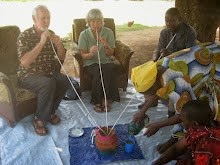
Speaking of the children: They are everywhere in our photos, and often swarming around Theresa. I chose the photo here, taken at dinner at Prossy's house, because who would have thought one of the things she would accomplish would be teaching a gang of kids to do the hokey-pokey? (They were very quick studies, especially the girls!)
The women: She became part of the Bead for Life family, and a personal part, at that, with her close – sometimes emotional – relationships with the women who make the beads, and who are finally finding a life of stability after some of the most unimaginable experiences possible. These women are clinging to Theresa and telling her she cannot leave, and that is a wonderful tribute. She worked hard on this project, bringing both her management skills and her human skills to it. She touched many people; she was touched by them.
The support for me: We knew that I couldn’t do this enormous undertaking without drawing on Theresa’s journalistic and leadership background, and I couldn’t have! Having her help lead all the upcountry training sessions, the management retreat, and critique and contribute ideas to pretty much all of my other programs made the work not only more successful, but a LOT more fun.
Yesterday at her goodbye party at Bead for Life (see photo at top, with her wonderful friend Mary), along with all they said about the work she did for the organization, many of the beaders and staff talked about what Theresa brought them with her wonderful sense of humor. "Thank you for making us laugh," Maureen said. "You have been good medicine for our hearts."
Well done.
 nding ovation itself. No, this is about the OTHER stuff you have done during our little Ugandan adventure. As our British friends said to us after we walked the Cotswold Way: “Well done!”
I was lucky. I came here with a very organized purpose and structure. I knew what I supposed to do, generally speaking, and my host was a well-established newspaper with all sorts of built-in organizational and support structures. Theresa came knowing she would do something, but with NO idea what that would be. Ha. No problem. It’s been so great to see how much she accomplished, how many connections she made, and what a difference she made for so many people in Uganda. It’s a gigantic part of the reason why we had such a rich time here -- and why we are as sad to leave so many people and things as we are excited to be returning home to so many others.
I can’t and won’t catalog everything, although “catalog” itself isn’t a bad choice of words because one of her legacies will be in the realm of libraries – the organizing of books at the orphanage, but especially, the fact that those children are finally starting to READ the books, or have other read to them. This is huge.

Speaking of the children: They are everywhere in our photos, and often swarming around Theresa. I chose the photo here, taken at dinner at Prossy's house, because who would have thought one of the things she would accomplish would be teaching a gang of kids to do the hokey-pokey? (They were very quick studies, especially the girls!)
The women: She became part of the Bead for Life family, and a personal part, at that, with her close – sometimes emotional – relationships with the women who make the beads, and who are finally finding a life of stability after some of the most unimaginable experiences possible. These women are clinging to Theresa and telling her she cannot leave, and that is a wonderful tribute. She worked hard on this project, bringing both her management skills and her human skills to it. She touched many people; she was touched by them.
The support for me: We knew that I couldn’t do this enormous undertaking without drawing on Theresa’s journalistic and leadership background, and I couldn’t have! Having her help lead all the upcountry training sessions, the management retreat, and critique and contribute ideas to pretty much all of my other programs made the work not only more successful, but a LOT more fun.
Yesterday at her goodbye party at Bead for Life (see photo at top, with her wonderful friend Mary), along with all they said about the work she did for the organization, many of the beaders and staff talked about what Theresa brought them with her wonderful sense of humor. "Thank you for making us laugh," Maureen said. "You have been good medicine for our hearts."
Well done.
Monday, September 24, 2007
Dr. Journalism's Big Day
 Last Friday night the New Vision gave a big party to say goodbye to "Dr. Journalism," as Bill is known at the paper. It was a great event, lots of speeches (of which the Ugandans are very fond), gifts, and a presentation of a kanzu (traditional white tunic) to Bill and a butusi (traditional dress; yes, with the pointy sleeves) to me. While mine has yet to be tailored, Bill was able to don his immediately. He handed out certificates to those who had completed his training sessions and shook hands with everyone - all in the kanzu.
I must admit that I kept expecting him to bless someone, since he looked just like a priest. The other picture is of him, pre-kanzu, with the managing editor, Els De Temmerman, and one of the top editors.
The folks at the New Vision have been amazing to us all along, but the thing that struck me at this event was how much they value Bill and how much they like him. O f course, I am biased, but it is so obvious - they hang on his every word. He got the title "Dr." because of a weekly newsletter he writes critiquing the paper. (This morning I was at the paper for a meeting and someone called him over by saying, "Doctor! I need to ask you something.")
Many of the speakers at the dinner said they now think "what would Dr. Journalism say" before they write. There was a theme to the comments beyond that: they learned to pay attention to readers, and to interview the affected parties instead of reinterpreting press releases. (Bill hammered home two questions they were to ask with every article: Who Cares?, and So What?) When Bill got up to speak, I was so proud of him -- of what he has done, the friends he has made in the journalism community here, and how important he has been to journalism in Uganda.
So now we are really wrapping it up: Our car, little topapa, has been sold and we are on foot again, the bank account is closed, our last mail at Matthias's PO box has been collected, there has been a farewell party, and we have been graced with traditional garb. More about goodbyes in the coming days ...
Thursday, September 20, 2007
Getting from here to there
There are many ways to get from here to there in Uganda. None of them involves multilane highways, smooth roads or trains, but all of them are interesting in their own way. There is walking, of course: even on the major roads between cities we never drive far without seeing at least a couple people walking along the side of the road, and when it is market day in the nearby village there is a stream of people.
There are the dangerous buses, which rocket down those highways without regard to potholes or, for that matter, little Topapa with me gripping the wheel and Theresa trying not to look as they speed by with perhaps an inch or two to spare. There are boda-bodas -- bicycles and motorcycles both -- that are one of the most popular forms of mass transit. (Yes, they are mass transit, because sometimes there may be as many as four passengers on a single motorbike.)
And then there are the ubiquitous matatus -- the "taxis," as they call them, really little minibuses with a stated capacity of 14 that is often exceeded. You see them EVERYWHERE in the city, darting in and out, and on every road around the country.
And the place they all come from is this....the Old Taxi Park in Kampala.
Well, they don't all come from here. There's a New Taxi Park too, and naturally there are smaller taxi parks in towns and villages all around Uganda. But this is the grandfather taxi park. Taxis from here go to destinations east of Kampala, and as you can perhaps see, it is a large challenge just to find the right one. There are little red signs marking destinations, which helps a little. There is a small marketplace. There are people with luggage they have to cram inside, pile on the top or tie on the back. (Can you see a small mattress tied to the back of one of the taxis in the right foreground? You see those everywhere, apparently as people move from one home to another.)
All aboard!
There are the dangerous buses, which rocket down those highways without regard to potholes or, for that matter, little Topapa with me gripping the wheel and Theresa trying not to look as they speed by with perhaps an inch or two to spare. There are boda-bodas -- bicycles and motorcycles both -- that are one of the most popular forms of mass transit.
 (Yes, they are mass transit, because sometimes there may be as many as four passengers on a single motorbike.)
And then there are the ubiquitous matatus -- the "taxis," as they call them, really little minibuses with a stated capacity of 14 that is often exceeded. You see them EVERYWHERE in the city, darting in and out, and on every road around the country.
And the place they all come from is this....the Old Taxi Park in Kampala.
Well, they don't all come from here. There's a New Taxi Park too, and naturally there are smaller taxi parks in towns and villages all around Uganda. But this is the grandfather taxi park. Taxis from here go to destinations east of Kampala, and as you can perhaps see, it is a large challenge just to find the right one. There are little red signs marking destinations, which helps a little. There is a small marketplace. There are people with luggage they have to cram inside, pile on the top or tie on the back. (Can you see a small mattress tied to the back of one of the taxis in the right foreground? You see those everywhere, apparently as people move from one home to another.)
All aboard!
Monday, September 17, 2007
A Ugandan wedding
Thanks for all the emails about Fatuma. Yes, she is an inspiration. Now for some more Ugandan culture:
A few weeks ago our friend Jennifer invited us to her sister’s wedding reception (actually, one of her many half-sisters from her father’s co-wives). Eric was still here and we all went to experience the Ugandan event.
The setting was a lovely green field stretching down to Lake Victoria. The field was decorated like a wedding cake: white pillars with large orange bows and flowers everywhere, even a huge wedding cake rotating high on a platform. In the middle was a “castle for the bride,” as it was translated for us. This was a kind of raised room with a canopy, all covered in white and orange, with tiny white lights and candles illuminating the table for the wedding party.
The reception included music from some of the best bands and pop stars in Kampala, good music with lots of drums. The wedding party arrived in a car tied with huge ribbons. This is customary – we see them every weekend all over the city, cars with ribbons stretching over the roof and in front of the radiator, sometimes decorated with a huge bow, sometimes other things, like a big straw hat.
 Everything was similar to an American wedding except for one thing. When it was time, the bride and groom cut the cake and then the groom sat in a chair and the bride knelt in front of him to feed him a piece of cake. Okay, so there is little women’s liberation here, but still! (Girls and women often kneel here. If I -- a white, older woman -- meet a young girl, sometimes she will fall to her knees with her hands folded, mumbling some welcome very quietly. Even our housegirl, Prossy, will kind of genuflect if you do something for her. It makes me very uncomfortable. Usually I tell them to stand up please!)
After speeches and lots of music, everyone got into a line to deliver the gifts. Eric very bravely took ours up (we didn’t know the bride or groom, and we were the only mzungus there – it was slightly embarrassing). And there was dinner – traditional Ugandan food eaten with the fingers, no silverware. We are getting pretty good at picking up rice with our fingers.
And then the dancing started. Again, Eric represented us ably. And that was it for our wedding experience – we went home much earlier than the native partiers. It was nice of Jennifer to include us in her family event; maybe someday the groom will kneel in front of the bride at a Ugandan wedding, but I won’t hold my breath!
A few weeks ago our friend Jennifer invited us to her sister’s wedding reception (actually, one of her many half-sisters from her father’s co-wives). Eric was still here and we all went to experience the Ugandan event.
The setting was a lovely green field stretching down to Lake Victoria. The field was decorated like a wedding cake: white pillars with large orange bows and flowers everywhere, even a huge wedding cake rotating high on a platform. In the middle was a “castle for the bride,” as it was translated for us. This was a kind of raised room with a canopy, all covered in white and orange, with tiny white lights and candles illuminating the table for the wedding party.
The reception included music from some of the best bands and pop stars in Kampala, good music with lots of drums. The wedding party arrived in a car tied with huge ribbons. This is customary – we see them every weekend all over the city, cars with ribbons stretching over the roof and in front of the radiator, sometimes decorated with a huge bow, sometimes other things, like a big straw hat.
 Everything was similar to an American wedding except for one thing. When it was time, the bride and groom cut the cake and then the groom sat in a chair and the bride knelt in front of him to feed him a piece of cake. Okay, so there is little women’s liberation here, but still! (Girls and women often kneel here. If I -- a white, older woman -- meet a young girl, sometimes she will fall to her knees with her hands folded, mumbling some welcome very quietly. Even our housegirl, Prossy, will kind of genuflect if you do something for her. It makes me very uncomfortable. Usually I tell them to stand up please!)
After speeches and lots of music, everyone got into a line to deliver the gifts. Eric very bravely took ours up (we didn’t know the bride or groom, and we were the only mzungus there – it was slightly embarrassing). And there was dinner – traditional Ugandan food eaten with the fingers, no silverware. We are getting pretty good at picking up rice with our fingers.
And then the dancing started. Again, Eric represented us ably. And that was it for our wedding experience – we went home much earlier than the native partiers. It was nice of Jennifer to include us in her family event; maybe someday the groom will kneel in front of the bride at a Ugandan wedding, but I won’t hold my breath!
Wednesday, September 12, 2007
Living with demons
 Yesterday I was at the BeadforLife office interviewing some women with an audio recorder. I have written many biographies of these women, but the US office wants some recordings so people can hear their voices. Thanks to the cute little recorder that Eric donated and Anna brought, I can capture the soft, lilting cadence (and high ululations!) of these ladies.
But I’ve had some problems. I recorded one woman, Fatuma, a new beader, two weeks ago, only to discover that she is so soft spoken that the recorder (on voice activation setting) kept cutting out. She was eloquent – she was abducted when she was 13 years old by the rebels in the north, then released, then discovered she was pregnant. A British woman took her and her son to Kampala but abandoned her here. Then she married and had three more kids – one born with disfigured limbs. When she was pregnant again, her husband died. As is normal when this happens, his family took everything she had – except the kids. Fatuma had no money, no prospects, so she moved to a slum in Kampala. The source of water is runoff from beside the railroad tracks. There is illness, violence, stench - the stuff of poverty.
So yesterday I asked, with apologies, if Fatuma could tell me her story again, painful as it is. We talked about how people in the US can read about something and still not feel it, but when they hear it from the person herself, they begin to understand. And she was willing.
But this time the telling was different. We sat in a little spare room at the office, me in a wooden chair holding the little recorder, and Fatuma sitting tall in a wicker chair. Wearing a blue headcloth, she was extremely pretty -- very black as Ugandans go, startling white teeth, young (about 30) and strong-looking (that is her picture above). This time Fatuma skimmed over the part about being abducted and went on to talk about how she has bought a popcorn machine and moved out of the slum, thanks to BeadforLife. That was fine, but then I asked her to please tell about what happened to her. So she started, now in more detail.
It was precisely 10 in the morning, she said, almost whispering. She was in school and the students were starting to go for their morning break. Suddenly the teachers realized the school was surrounded by rebels. “They let the ones in P1, P2 and some of P3 go,” Fatuma said. “Everyone else had to go out the door in a line.” Some, like her, they took. Others had a different fate. If they tried to resist or to help someone else, they were killed. “And the way they were killed was not good,” Fatuma said, looking at me with eyes that truly were pleading. “They took pangas (machetes) …” Suddenly she stopped. Her hands just lay in her lap. She was no longer looking at me – her eyes were not seeing anything in the little room, they were just seeing something that has never been erased from her memory. We sat that way for awhile, she was breathing hard, then started gulping as she tried to talk. I turned off the recorder (I am no Mike Wallace!), and told her to stop. I put my arms around her, held her stiff hands in mine and she finally started crying. I tried to talk to her about her children, how they had a future, how she did too now, how it was time to look ahead and not back. How strong she had been, things like that. But what can you say, really?
She said she tells her children that such things can happen in life and you need to be prepared for them. And she told me she was lucky. She was released by the rebels and some soldiers found her along the road, first thinking she was a rebel too. When she convinced them she was not, they took her home. The luckiest thing: she did not get AIDS. And she raised the son she bore from this experience. He is now 16.
Later, a bunch of us from BeadforLife were having lunch. I told Fatuma’s story, and one of the young women on the staff said, “Did she commit atrocities?” I knew where this was going. Bill and I have both read “The Aboke Girls,” a book about abduction in the north. The girls who were taken were sometimes forced to kill each other and people they met accidentally. And when they returned (those that did) others were quick to condemn them. I said I didn’t know if Fatuma had done this, and what difference did it make anyway. “What would you do?” I asked this young woman. She didn’t answer, but I could see what she was thinking: she is a Buganda and Fatuma is Acholi – tribal differences run deep.
Later in the day I interviewed a young man whose parents were burned in a cult murder in 2003. He wants to be a nurse. And a woman who ran from the north when soldiers were cooking people in pots – I asked her if she saw them and she said, “Of course, it was right in the road.” She is raising five kids, and her two sisters.
These things are not distant history, they are alive in people’s minds and in their hearts -- and in today’s reality. Man’s inhumanity to man can take the shape of pangas and rebels, or of judgment and bias. Or of war close-up or in a far-off country full of people different from you.
I was sorry to have made Fatuma remember it all again. But her story is important for a thousand reasons. Hearing it in her voice, seeing it in her face ... it's something I will never forget. I wish I knew what to do about it.
Tuesday, September 4, 2007
Blog pressure
Okay, okay. All of you who have been emailing us saying we haven't upd ated the blog, we know. We are one month away from coming home, and things are getting a little frantic. Our car, little Topapa ("be patient"), has a For Sale sign on it, sadly enough. We have had such fun in that car! Our friend Fr. Matthias returned from the USA and was kidnapped by the archibishop to be a vice chancellor, whatever that is. He now wears a collar all the time; we had never seen him in one before. Bead sales continue, beaders tell sad stories, and success stories too. Mostly, Eric tacked on a week to his visit and has been making himself useful. He experienced an African stomach bug (about half our visitors have had this memorable experience), and then chronic hiccups cured only by his mother's advice: drink water upside down. Despite trips to the bathroom he has written
 an entire library program for Sister Schools - the orphanage in Kajjansi is the first beneficiary, but not the last.
So life for us goes on. We will try to be better correspondents in the next few weeks.
Per those questions about how we will feel leaving: both things are true. We will miss Uganda horribly: our friends here and their open faces, the little parafin lamps at night on the walk to Pavement Tandoori, the "jams," the color, the dust - the difference! We are on a round of dinner with Ugandan friends.

 ated the blog, we know. We are one month away from coming home, and things are getting a little frantic. Our car, little Topapa ("be patient"), has a For Sale sign on it, sadly enough. We have had such fun in that car! Our friend Fr. Matthias returned from the USA and was kidnapped by the archibishop to be a vice chancellor, whatever that is. He now wears a collar all the time; we had never seen him in one before. Bead sales continue, beaders tell sad stories, and success stories too. Mostly, Eric tacked on a week to his visit and has been making himself useful. He experienced an African stomach bug (about half our visitors have had this memorable experience), and then chronic hiccups cured only by his mother's advice: drink water upside down. Despite trips to the bathroom he has written
 an entire library program for Sister Schools - the orphanage in Kajjansi is the first beneficiary, but not the last.
So life for us goes on. We will try to be better correspondents in the next few weeks.
Per those questions about how we will feel leaving: both things are true. We will miss Uganda horribly: our friends here and their open faces, the little parafin lamps at night on the walk to Pavement Tandoori, the "jams," the color, the dust - the difference! We are on a round of dinner with Ugandan friends.

But we will be so happy to see our family, those growing grandkids with missing teeth and new inches, Sarah's new house, Anna about to be married, Kate the teacher - oh, we are anxious to see all. And to see the Northwest and friends: the mountain hikes, a hug for the kayaks, dinners at Fred and Robin's and Taz's, rush tickets at the Rep.
But not yet. We are very much still here, soaking it up, eating matoke and savoring each adventure as it comes. Even if it doesn't appear in the blog.
But not yet. We are very much still here, soaking it up, eating matoke and savoring each adventure as it comes. Even if it doesn't appear in the blog.
Subscribe to:
Posts (Atom)